Did Minoans Track Solar Eclipses Using Hilltop Observatories And Ancient Eclipse Calculating Devices?
Herewith Greek Reporter journalist Dimitrios Aristopoulos' quite assertive answer to that question in his very recent article headlined:
Recent discussion surrounding the circular structure on Papoura Mountain on Crete has renewed interest in this topic. A report highlighted by Archaeology Magazine describes an unusual Bronze Age stone complex made up of eight concentric circles. Archaeologists date the site between 3000 and 1700 BC, noting that successive construction phases reflect long-term maintenance.
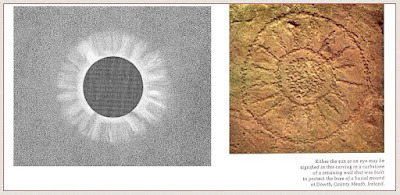
Researcher Robin Edgar, who has studied eclipse-related rituals, has pointed out that the structure resembles a rayed sun symbol with a cross at its center, suggesting symbolic engagement with solar phenomena. The combination of elevation and radial design implies deliberate alignment with the horizon and sky.
The circular structures occupy commanding positions. They are never hidden within valleys but stand exposed to light and weather, offering broad visibility of the horizon. Papoura Mountain provides precisely this vantage point. The concentric walls guide the eye toward a central focus while allowing communal gatherings. Such exposure is ideal for observing celestial events. Robin Edgar has emphasized that this architectural choice would have allowed Minoans to monitor rare solar events like total eclipses.

Archaeological evidence suggests long-term maintenance of the monument. Wall repairs, buttressing, and additions around the central circle occurred over centuries. This persistence reflects ritual significance. Moreover, ritual often responds to extraordinary natural phenomena, and among these, total solar eclipses would have stood out for their sudden and dramatic impact.
Astronomical reconstructions provide essential context. Using the eclipse databases compiled by Xavier Jubier, Robin Edgar has identified numerous total and annular solar eclipses visible over Crete between 3000 and 1700 BC. Within the earlier period, total solar eclipses occurred on May 24, 2929 and July 8, 2708. Several annular eclipses took place in the intervening centuries.
A remarkable sequence emerges in the nineteenth century BC. On January 9, 1861 (BCE), a total solar eclipse crossed Crete. Just over two years later, on May 15, 1859 (BCE), another total eclipse followed. Soon after, on October 27, 1858 (BCE), an annular eclipse passed over eastern Crete. Within less than four years, inhabitants experienced three major solar eclipses—two total and one annular. Such events would have had a profound psychological and cultural impact, particularly for a society attuned to celestial cycles.

Geography sharpens this picture. The site of Palaikastro, at Crete’s easternmost extremity, lay within the path of totality for all three eclipses. Residents would have witnessed complete solar obscuration twice and an annular eclipse soon after. Such repeated disruption of daylight likely demanded ritual attention and may have inspired technological experimentation.
The Palaikastro molds, dated to 1850–1700 BCE by Jan G. Velsink, potentially illustrate such innovation. Moreover, researchers in 2013 hypothesized that one mold could function as a template for a mechanical device capable of predicting eclipses—a possible Minoan “eclipse calculator.” Researcher Edgar notes that whether or not the mold performed calculations, its iconography aligns closely with solar symbolism observed in structures like Papoura. The temporal proximity of the mold to the 1861–1858 BC eclipse cluster suggests that the Minoans may have sought ways to understand or anticipate these dramatic events.

Papoura and the Palaikastro mould together provide complementary evidence of Minoan engagement with the sun. Papoura’s hilltop circular structure, with its concentric design, would have served as a communal ritual space for observing eclipses. The Palaikastro mould could represent an attempt to systematize knowledge of solar phenomena. Edgar highlights the correspondence between these artifacts. Both transform ephemeral celestial events into enduring cultural expression, whether through monumental architecture or symbolic, portable devices.
It's worth reading the full article for further information.

Comments
Post a Comment